


How to Calculate Hours Worked and Overtime Pay
A step by step guide to totaling your hours from a time card, converting minutes to decimals, and working out overtime and gross pay for the week.
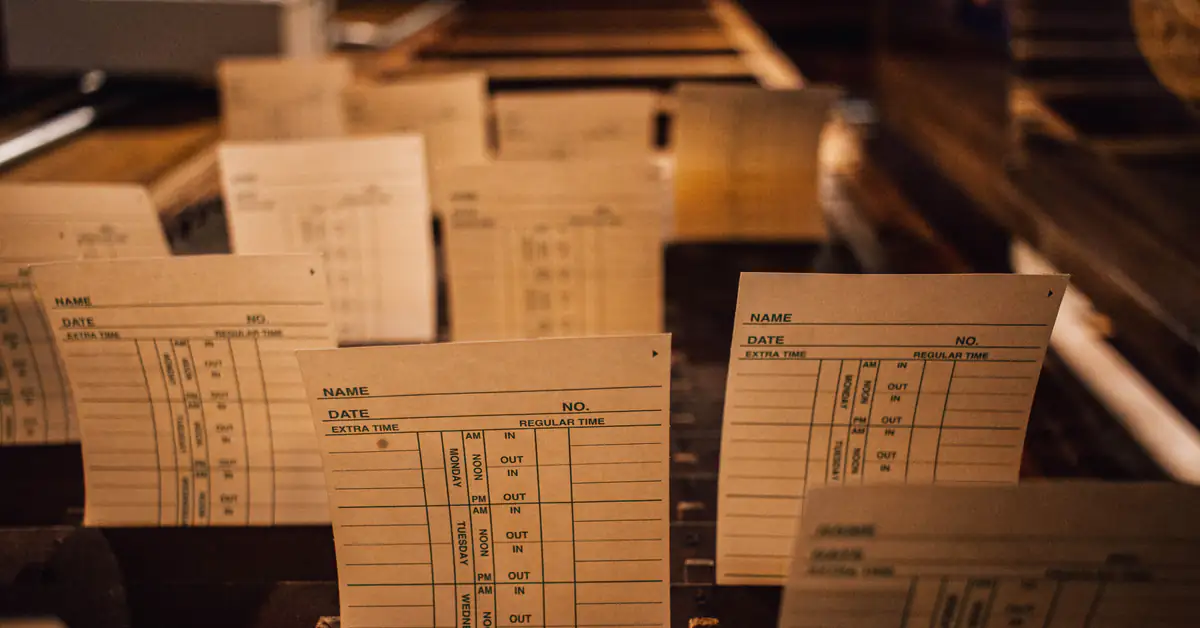
If you are paid by the hour, knowing your exact hours is how you check a paycheck, claim overtime and plan a budget. The math is simple once you break it into steps.
Step 1: Work out each shift
Subtract the start time from the end time. A shift from 8:00 a.m. to 6:00 p.m. is 10 hours. If the shift ends after midnight, add 24 hours to the end time first: 10:00 p.m. to 6:00 a.m. is 30 minus 22, or 8 hours.
Step 2: Take off unpaid breaks
Most meal breaks are unpaid, so subtract them. That 10 hour shift with a one hour lunch is 9 hours of paid work. Short rest breaks are usually paid, so check your employer’s policy.
Step 3: Convert minutes to decimals
Payroll works in decimal hours, not hours and minutes. Divide the minutes by 60: 15 minutes is 0.25, 30 minutes is 0.5 and 45 minutes is 0.75. So 7 hours 45 minutes is 7.75 hours, not 7.45.
Step 4: Add up the week and find the overtime
Add the days together, then compare the total with your overtime limit. Federal law counts overtime after 40 hours in a workweek and pays it at 1.5 times your rate. Five 9 hour days make 45 hours: 40 regular hours and 5 overtime hours.
Some states count by the day as well. California pays time and a half after 8 hours in a day and double time after 12, so the same week has 5 overtime hours there too, but a single 13 hour day would include 1 hour at double time.
Step 5: Turn hours into pay
Multiply regular hours by your rate, and overtime hours by your rate times the multiplier. At $20 an hour, the 45 hour week above pays 40 × $20 = $800 plus 5 × $30 = $150, or $950 before taxes.
A few things the simple math misses: rounding rules some employers apply to clock times, paid holidays, shift differentials and union contracts that pay more than the legal minimum. When your pay stub does not match your own total, those are the first places to look.